If the servants and staff during Magdalen’s first 350 years are known to us most often only by their names, their successors from 1800 onwards can be brought more sharply into focus, both as a group and as individuals.
Magdalen in the long nineteenth century was a markedly different place to today. Shaped by the presidencies of Martin Routh (1791–1854), Frederick Bulley (1854–85), and Herbert Warren (1885–1928), the college became more socially homogenous, with persons of high status representing nearly three-quarters of the undergraduate intake. Social distinctions therefore became more pronounced, and no more so than with regards to the servants and staff, some of whom were now fulfilling domestic tasks previously performed by servitor-scholars.
In some instances, members of staff consciously or unconsciously mimicked things at the top. In others, they sought deliberately to push back against them.
The best-known imitator was Richard Gunstone (1841–1924), the scion of a local family whose members had worked for Magdalen since at least the mid-seventeenth century. Known affectionately as ‘Gunner’, he served as Junior Common Room (JCR) Steward from 1880 to 1914, befriending undergraduates from Compton Mackenzie (1883–1972) to the future Edward VIII. At the other end of the spectrum were figures like Horace Richardson (1906–79), a member of the Magdalen buttery staff who, in the 1930s, attempted to unionise the college servants in the face of what he saw as deplorable (and all too meekly accepted) working conditions.
In the middle was the college itself, which took what might best be described as a paternalistic interest in staff wellbeing. A library was established and a chaplain appointed to cater to the servants’ educational and spiritual needs, while individual support might be given when deemed appropriate, such as when the Fellows agreed to help the daughter of a late porter travel to India.
More substantially, by the 1880s, college staff were able to join a pension and sickness benefit scheme, the former of which particularly benefitted long-serving members.
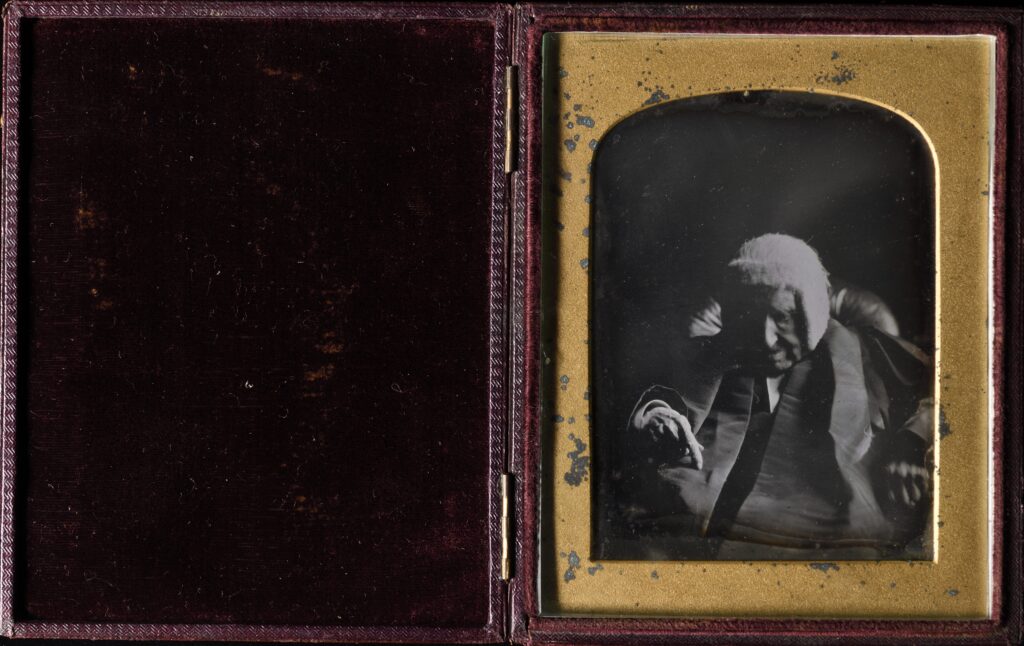
Daguerreotype
The presidency of Martin Routh (1755–1854) is one of the defining periods of Magdalen’s history. Elected in 1791, he served as President for 63 years, dying in post. His attitudes would have shaped many ideas at college, including in relation to its staff.
This daguerreotype was taken on Routh’s 99th birthday on 18 September 1854. In it, he can be seen wearing his famous wig, more typical of fashions of the 1750s than the 1850s. Surrounded by books and scholars his whole life, Routh’s last words were apparently spoken to his housekeeper: ‘Don’t trouble yourself’.
MCA, PR/30/4/P1/1
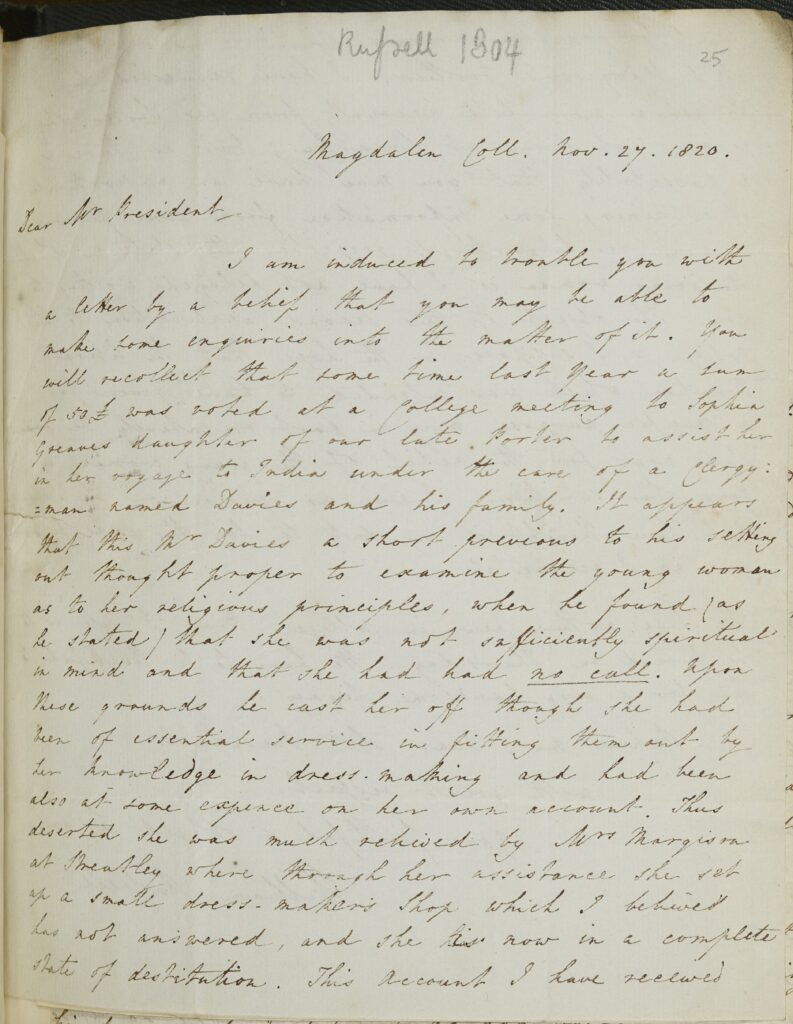
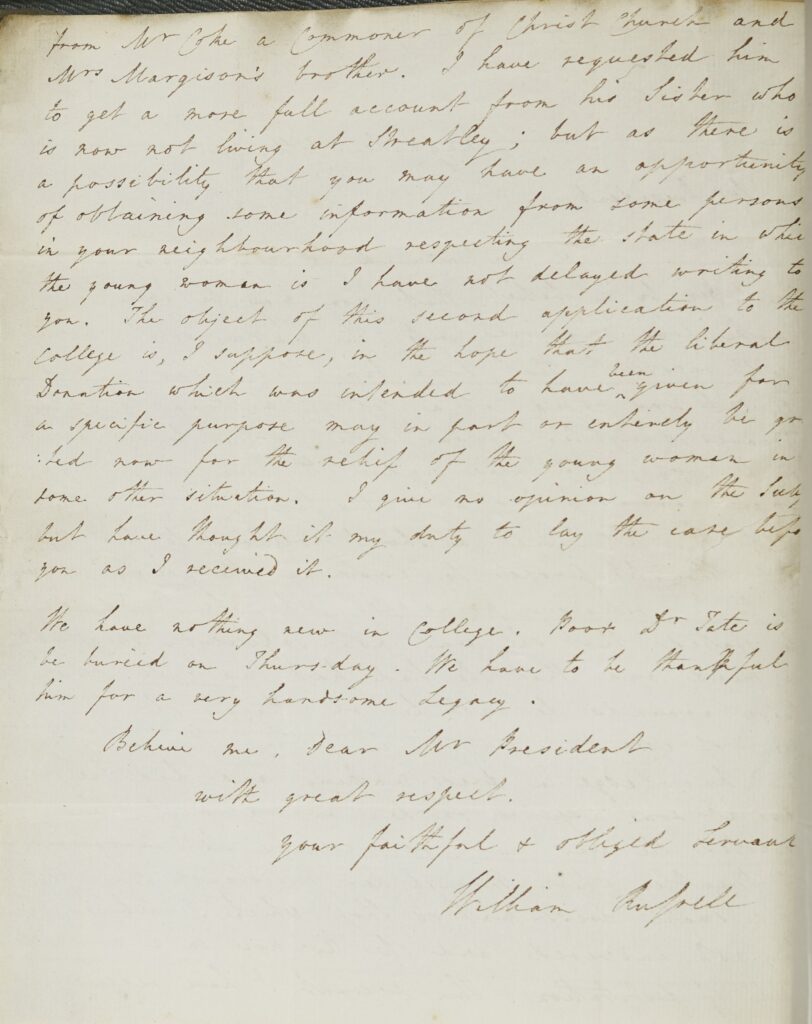
Charity
This letter, sent from William Russell (F 1815–31) on 27 November 1820, concerns one Sophia Graves, who was the daughter of Magdalen’s late porter. It recounts how the college had appropriated £50 to allow her to travel to India under the care of a clergyman named Davies. However, having found Sophia Graves ‘insufficiently spiritual in mind’, this Davies had cast her off, leaving her in a state of destitution. Russell asks that the £50 be put instead towards her relief.
MCA, PR/30/1/C2/10/25
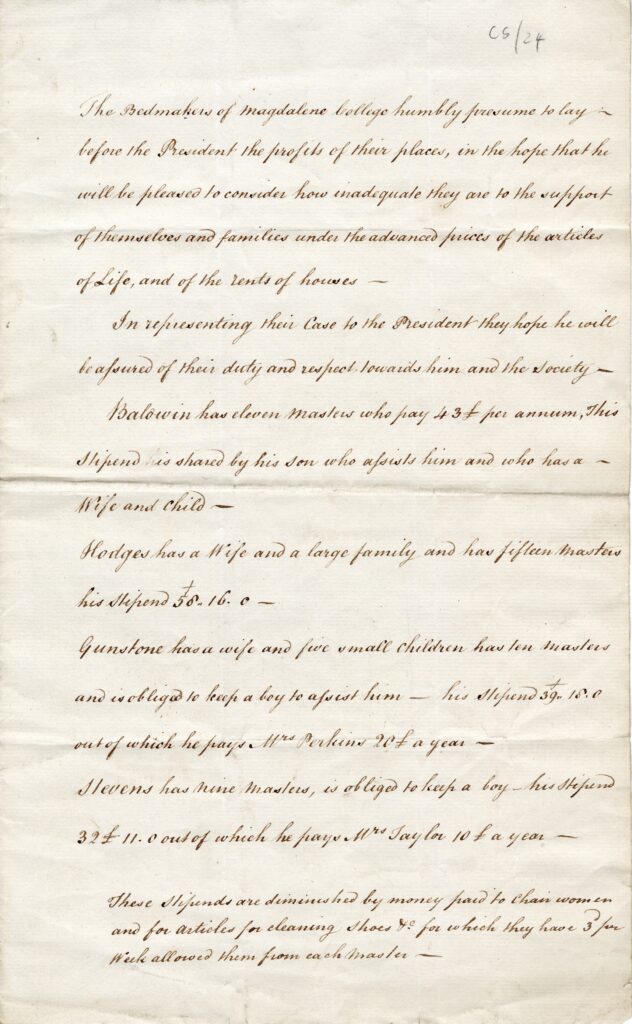
Bedmakers’ petition
As in the medieval and early modern periods, staff wages at Victorian Magdalen were often poor. Unlike their forbears, however, Magdalen’s nineteenth-century staff had fewer opportunities to supplement their income. But they had begun to find their collective voice.
This petition is issued in the name of the college bedmakers. It asks for an increase to their stipends, which they deem inadequate given ‘the advanced prices of the articles of Life’. Among the petitioners is one Gunstone, whose descendant, Richard Gunstone, became a legendary JCR Steward.
MCA, CS/24
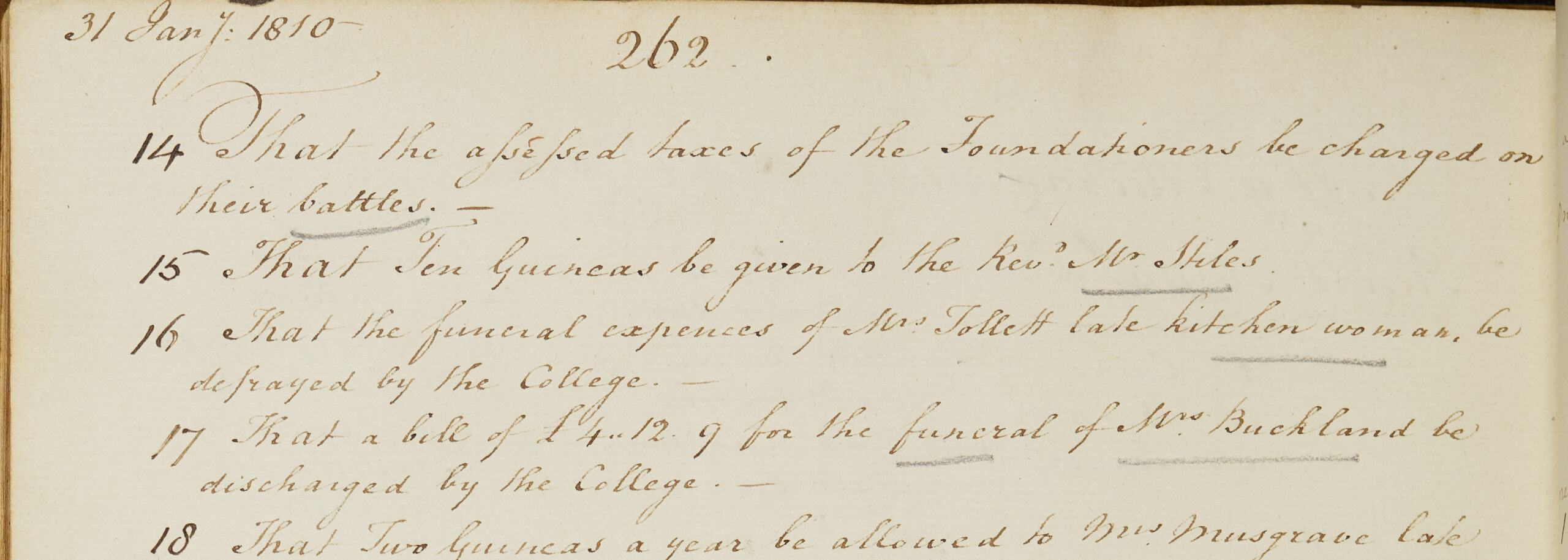
Governing Body meeting, 31 January 1810
The College decides to underwrite the funeral expenses of Mrs Tollett, who worked in the kitchen.
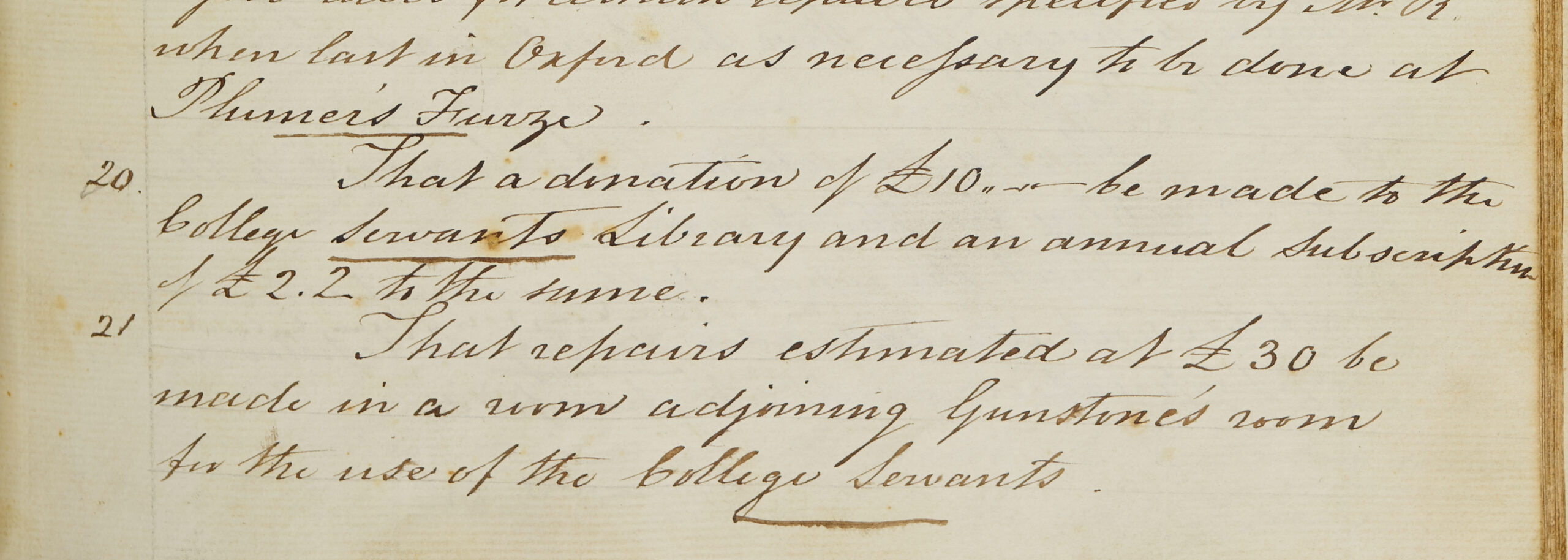
Governing Body meeting, 2 February 1854
The College agrees to make a donation of £10 towards the cost of a college servants' library.
Books and burials
In the nineteenth century, Magdalen took what might be best described as a paternalistic attitude towards the wellbeing of its staff.
These two extracts from college minute books illustrate such attitudes. The first, from 31 January 1810, records how the college decided to underwrite the expenses associated with the funeral of Mrs Tollett, who worked in Magdalen’s kitchen. The second, dated 2 February 1854, notes the £10 allotted by the college for a Servants’ Library. Sadly, what books were thought best to adorn the shelves of this library is unknown.
MCA, CMM/1/2, 4
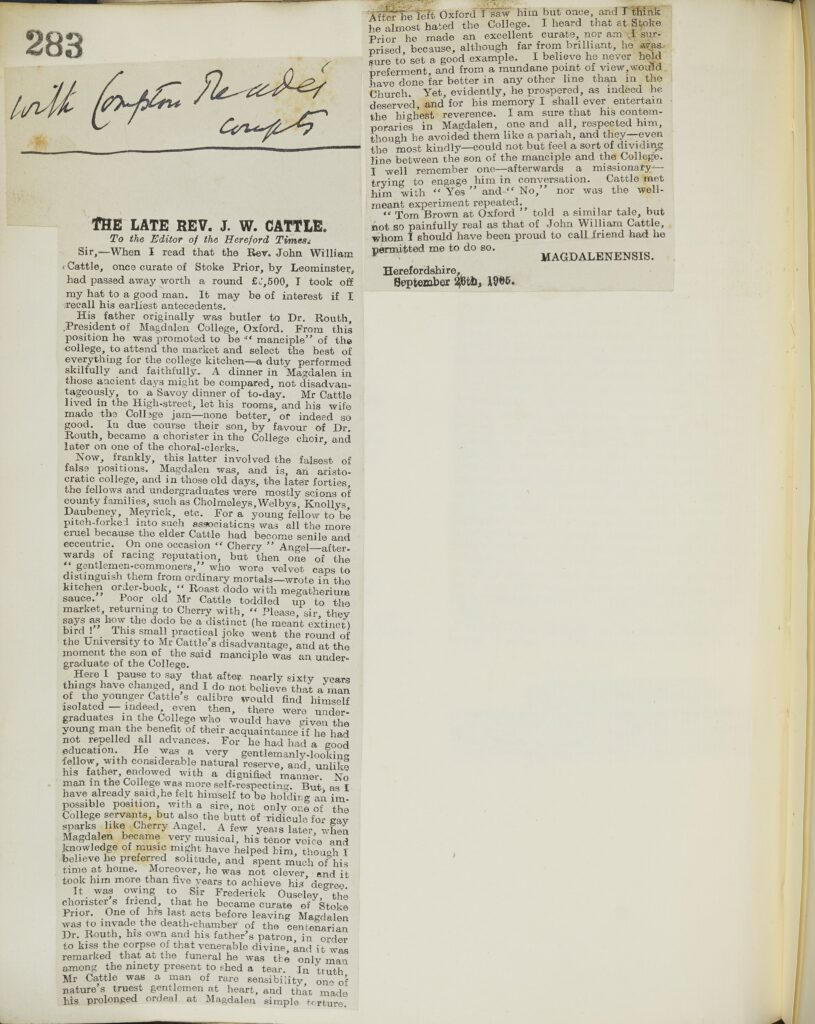
A cruel trick
Magdalen in the Victorian era would have been a place of sharp social and economic distinctions, not least between the college’s students, on the one hand, many of whom had been educated in England’s elite private schools, and its working class staff, on the other.
It is difficult to say how often such distinctions were a cause of anxiety or tension, but it is occasionally possible to find them captured in the college archive.
This newspaper extract is pasted into one of the ‘President’s Books’ of Herbert Warren (P 1885–1928). It is a letter that recounts, in part, the cruel trick played by Benedict John ‘Cherry’ Angell (1830–74), a Magdalen student, on William Cattle, the college’s manciple.
As the letter writer observes, the trick, which took advantage of Cattle’s limited education and declining mental faculties, was made all the more unkind by the fact that Cattle’s son, himself of working class origins, was then a student at Magdalen.
MCA, PR/2/15, p. 283
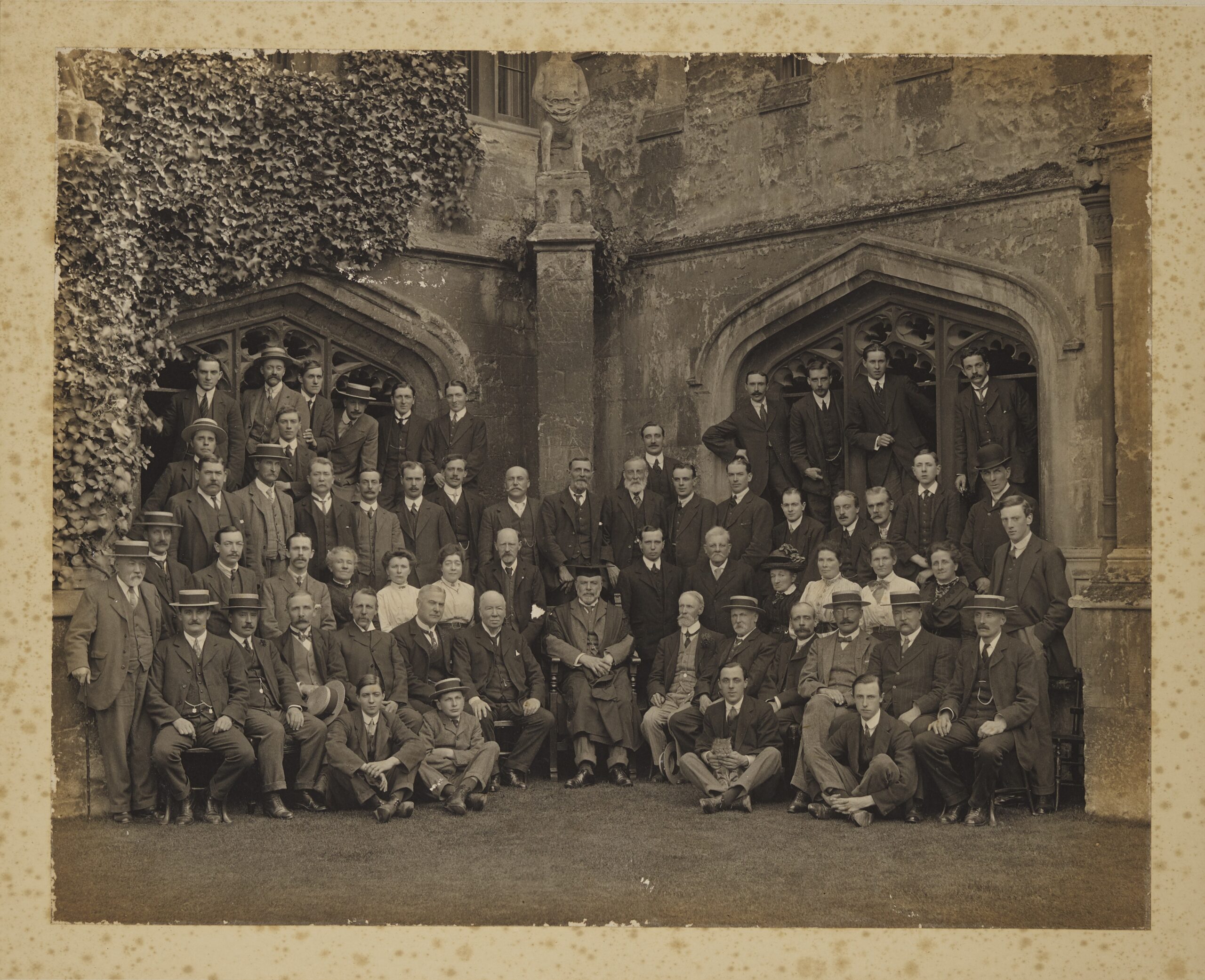
Herbert Warren
Magdalen College President, 1885-1928
Richard 'Gunner' Gunstone
JCR Steward, 1880-1914
Staff photo
This photograph captures all of Magdalen’s staff at some point in the early twentieth century. Seated at centre is Herbert Warren, then President. To his right is Richard Gunstone, who was JCR Steward between 1880 and 1914. Arrayed around them are over sixty members of staff, including seven women. The photo was most likely taken to mark Gunstone’s retirement, and the presence of so many, including Warren, vividly illustrates his standing at Magdalen.
MCA, CF/1/22
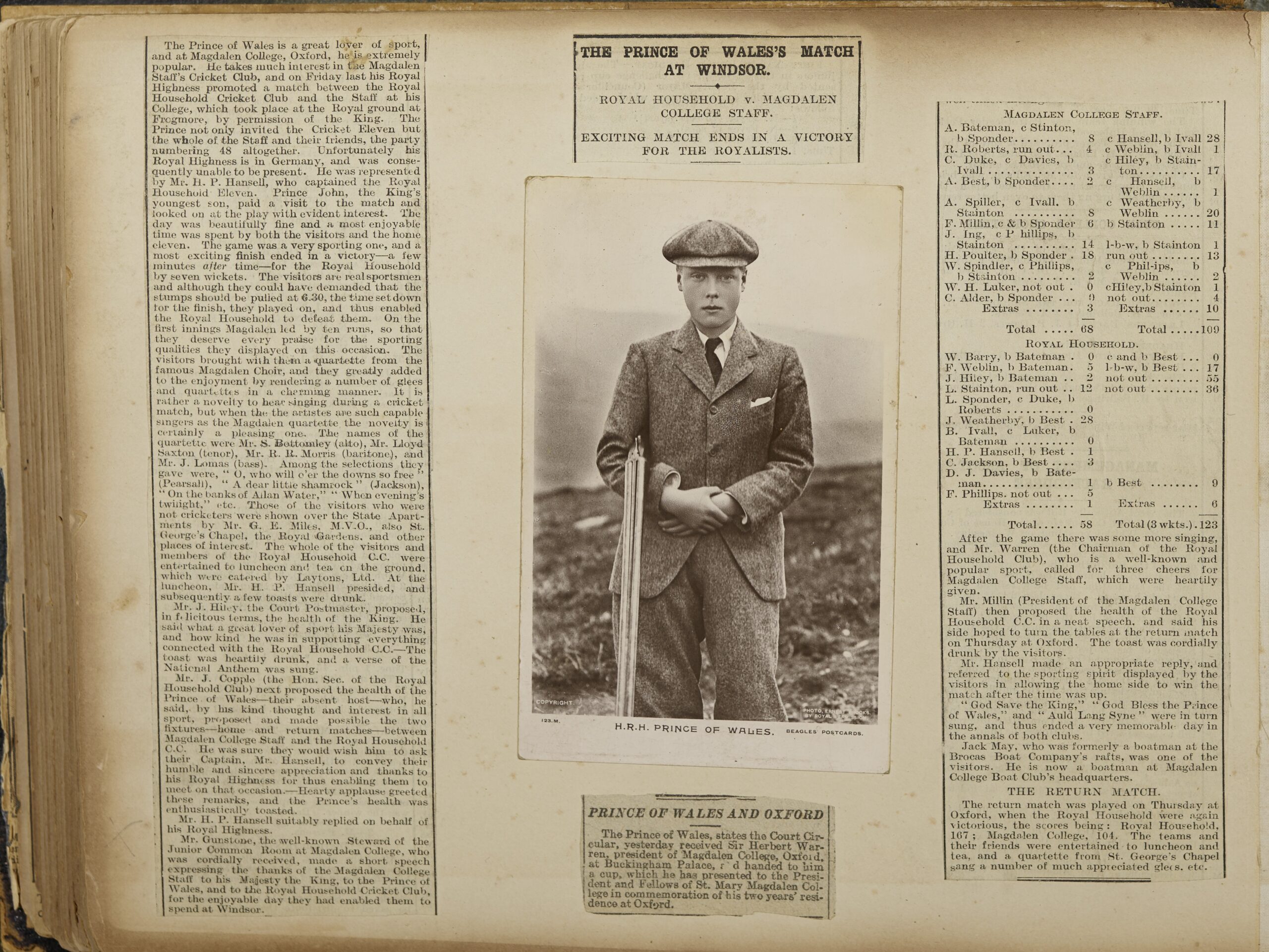
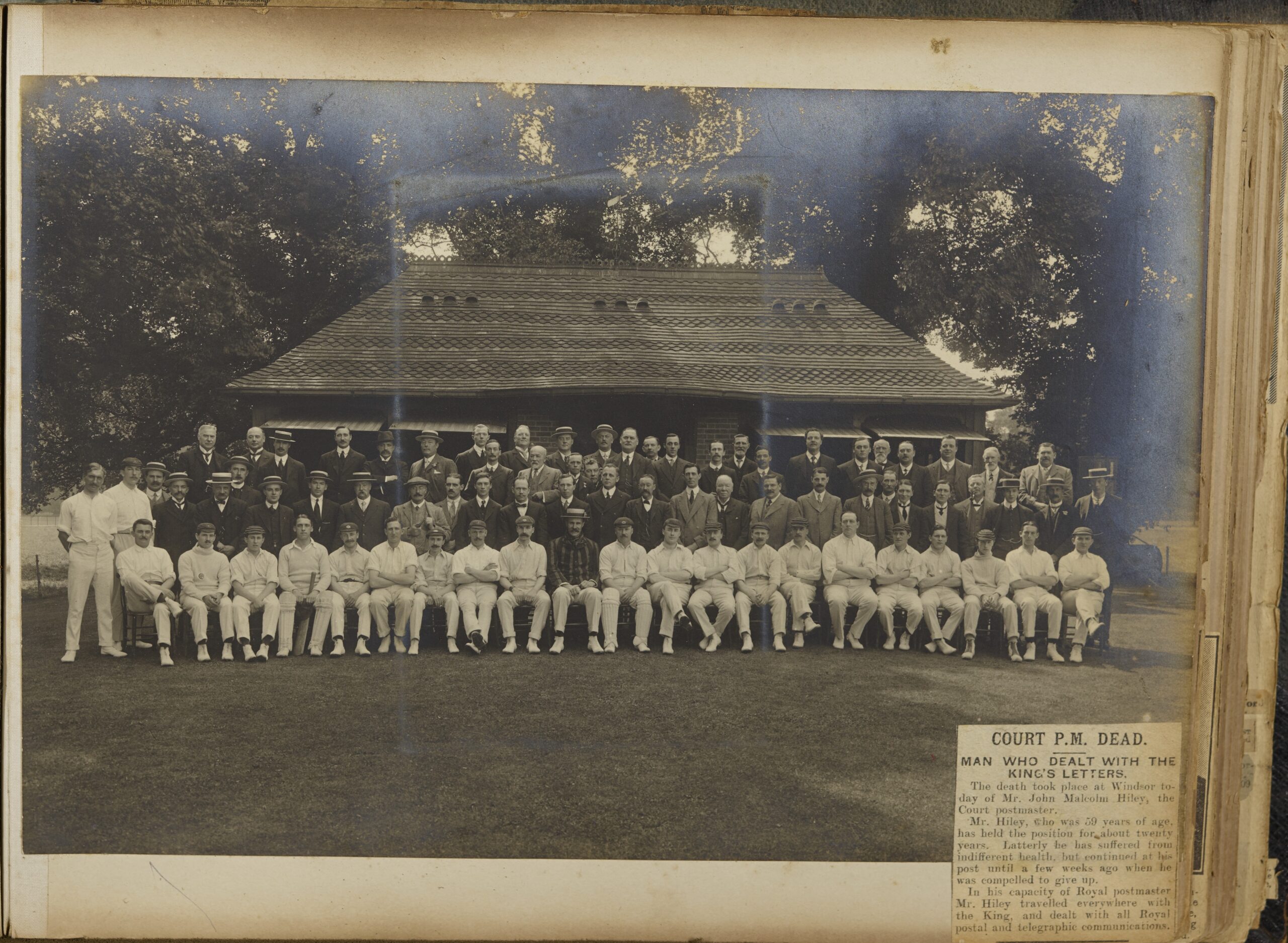
Scrapbook of Richard Gunstone, JCR Steward
Gunstone is captured here among the players from both sides in a cricket match between the royal household and the Magdalen College staff
Scrapbook
This scrapbook was compiled by Richard Gunstone during his time as JCR Steward. It contains photographs, cuttings, and other ephemera relating to Magdalen. It is packed with items concerning the ‘great and the good’ who passed through Magdalen’s doors, whom Gunstone would invite to his college room for drinks. Pictured above is the future Edward VIII. He arrived at Magdalen in 1912, and Gunstone came to know him well, to the extent that the prince organised two cricket matches between the Royal Household and the Magdalen staff, of which a news report and photograph are above. Gunstone himself gave a speech after the first match at Windsor.
MCA, Acc2014/175
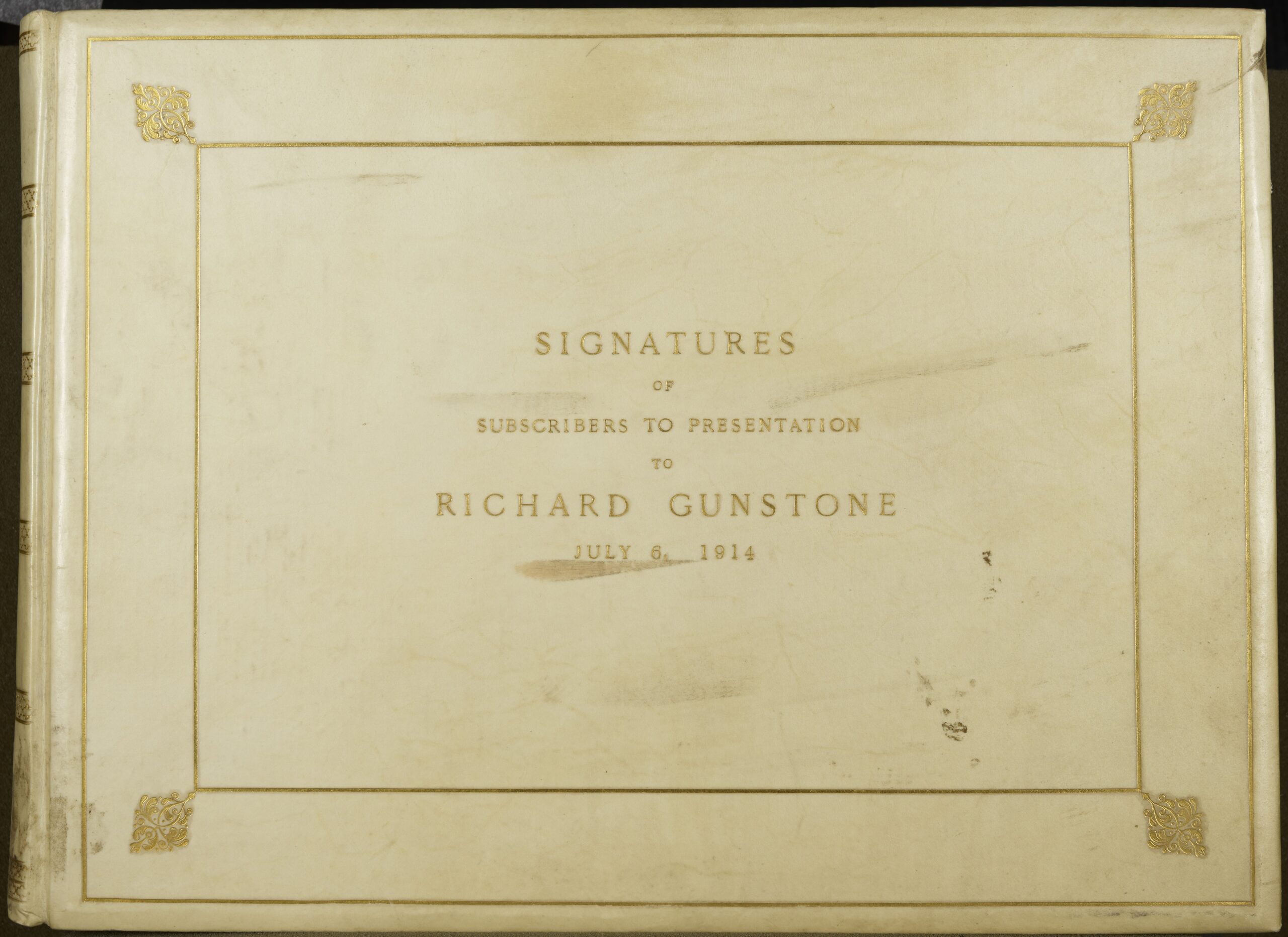
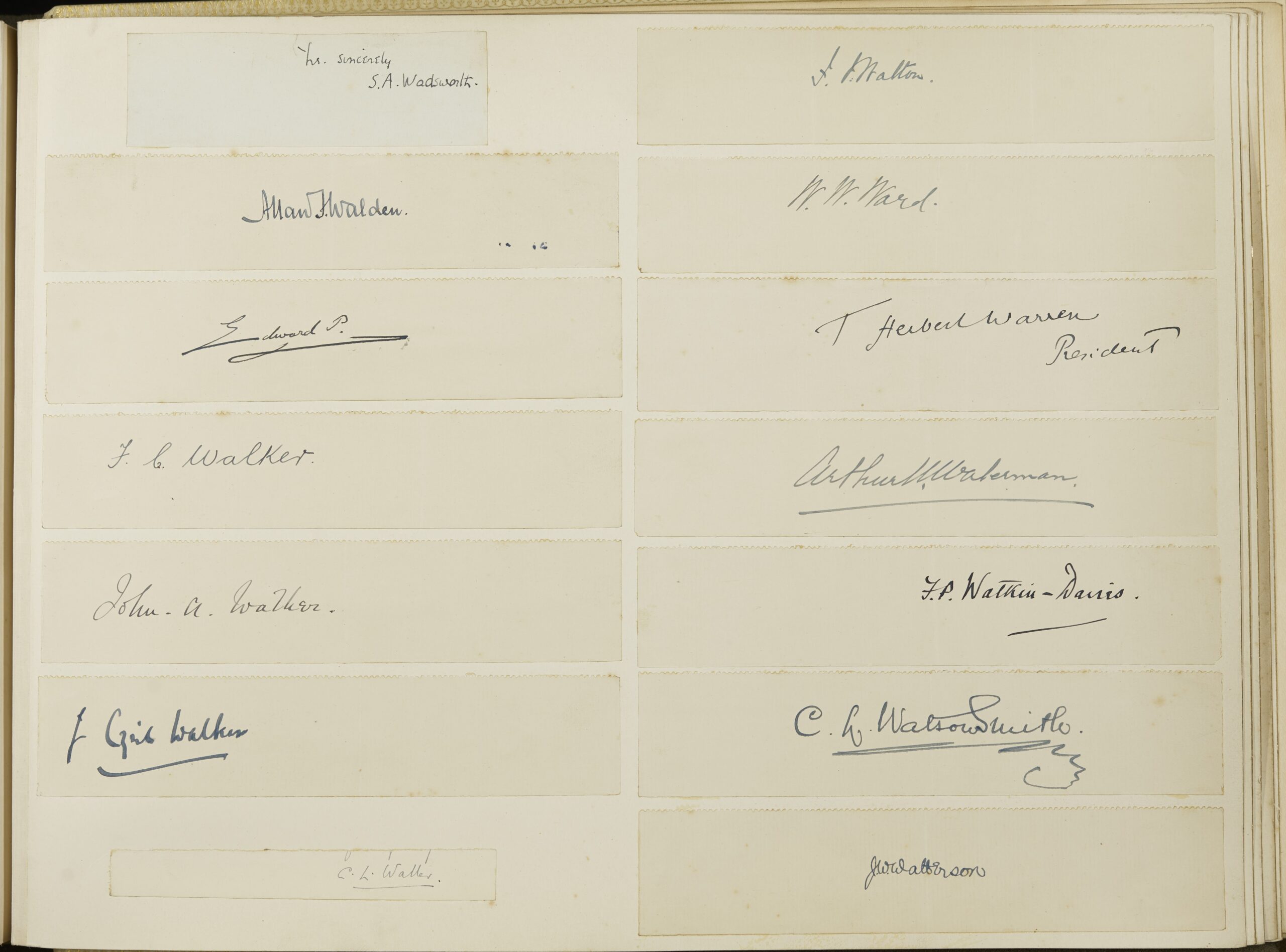
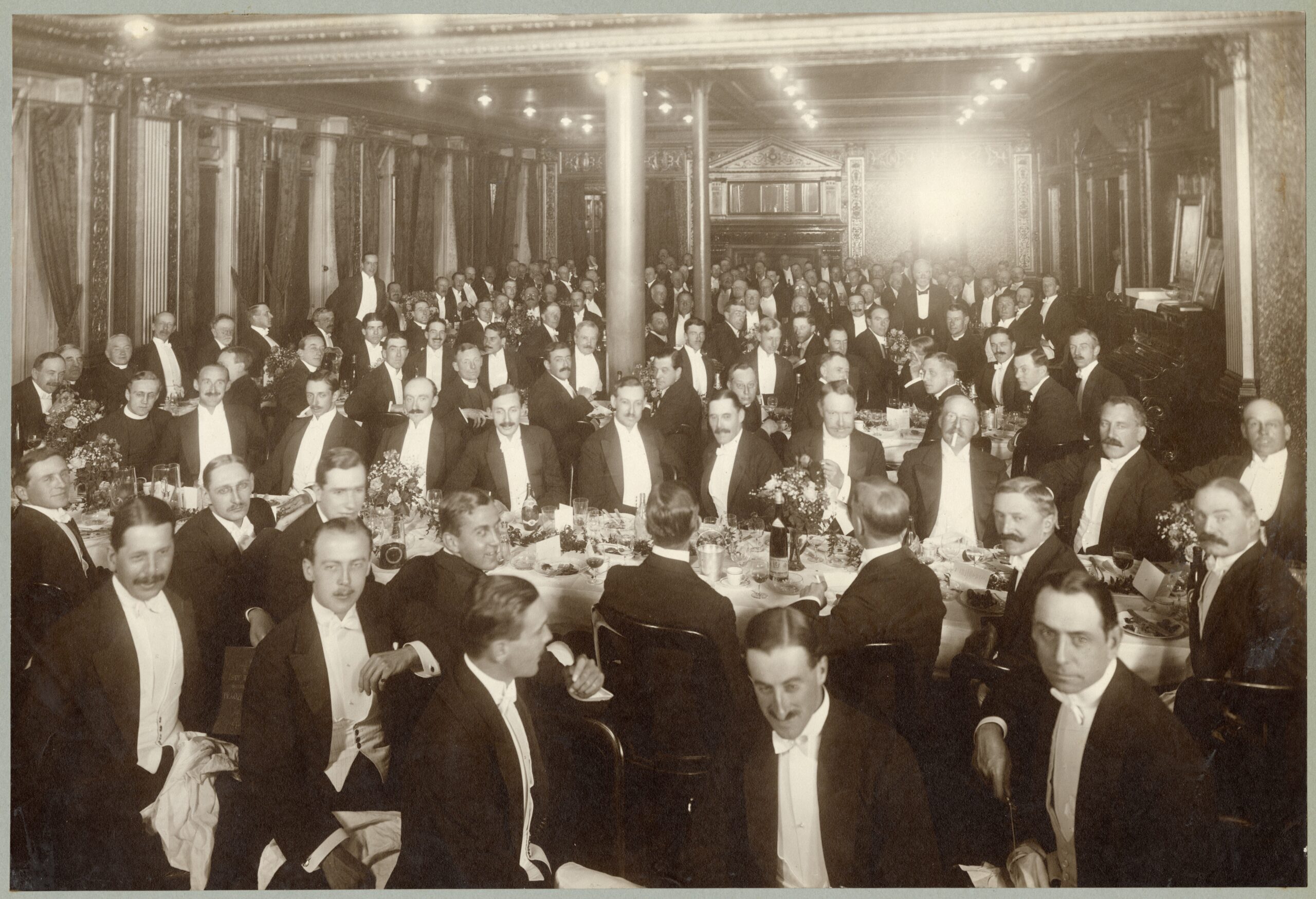
A royal send-off
Richard Gunstone’s retirement in 1914 marked the end of an era. As reward for his service, the college authorities resolved to present him with a sum of money. The total eventually raised was £1,351 (around £135,000 in today’s money), which was enough to pay Gunstone’s salary for life.
The cover of the associated subscription book is shown in the first image above. The second image shows a page of signatures in that subscription book. The signature of the future Edward VIII is in the left-hand column, third from the top. To the right of that is the signature of President Herbert Warren. Above his is that of William Welsford Ward (1854–1932), who was Oscar Wilde’s best friend during his days at Magdalen.
The third image is a photograph of the dinner held in Gunstone’s honour at the Café Royal on 6 July 1914, which was attended by around 200 people, including Prince Edward. Gunstone is the figure standing on the right.
MCA, MS/770 & P/201/P1/2/33
Letter
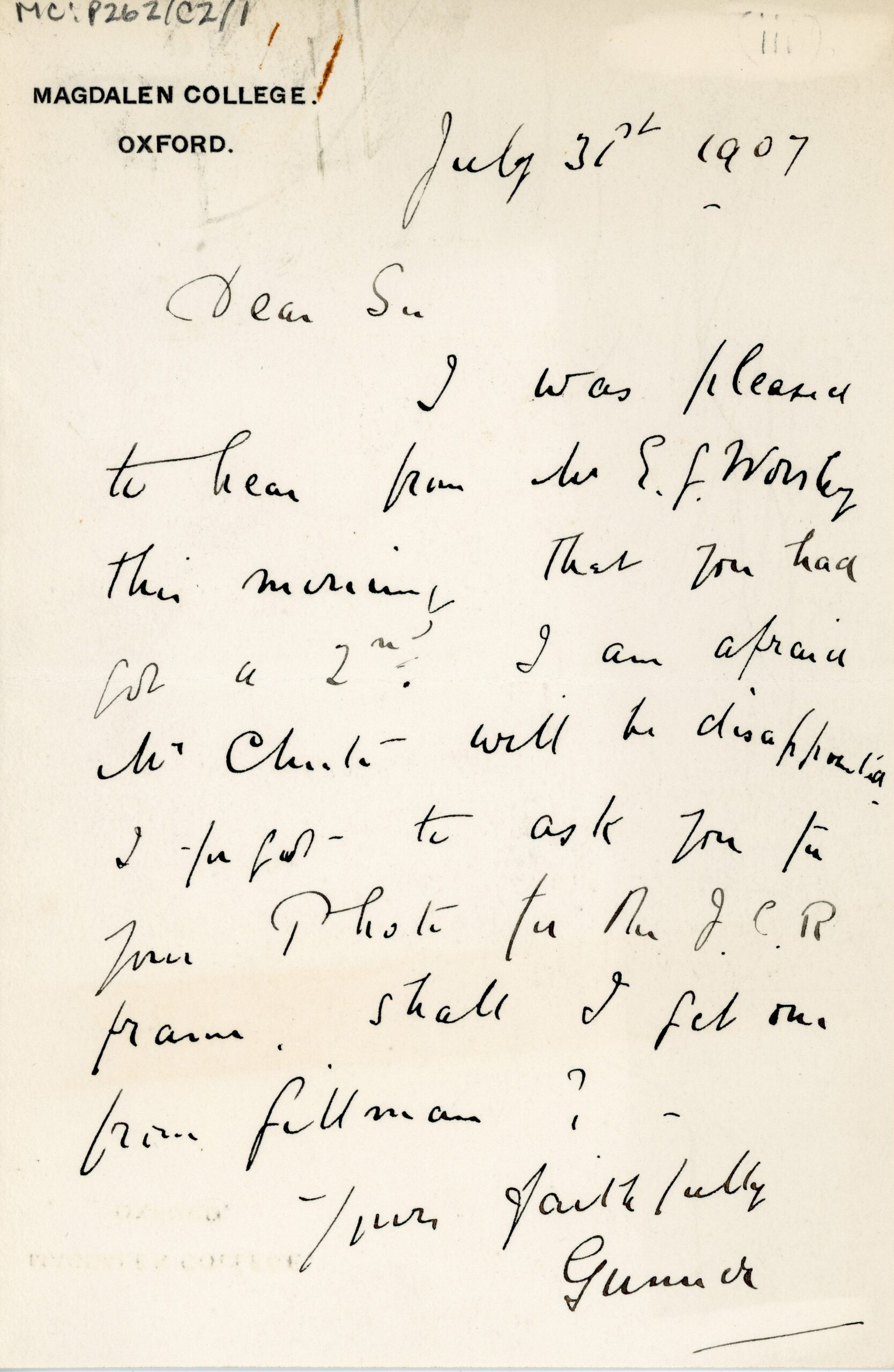
As well as entertaining them in his rooms and doling out advice, Richard Gunstone entered into correspondence with Magdalen students.
This letter is to Alan Campbell Don (1885–1966), who served as President of the JCR from 1906 to 1907. In it, Gunstone congratulates Don on the award of his degree and asks where he might secure a photo of him for the Junior Common Room.
The letter is signed ‘Gunner’, which is the nickname by which Richard Gunstone was known to all who passed through Magdalen at this time.
MCA, P/262/C2/1
Pensions
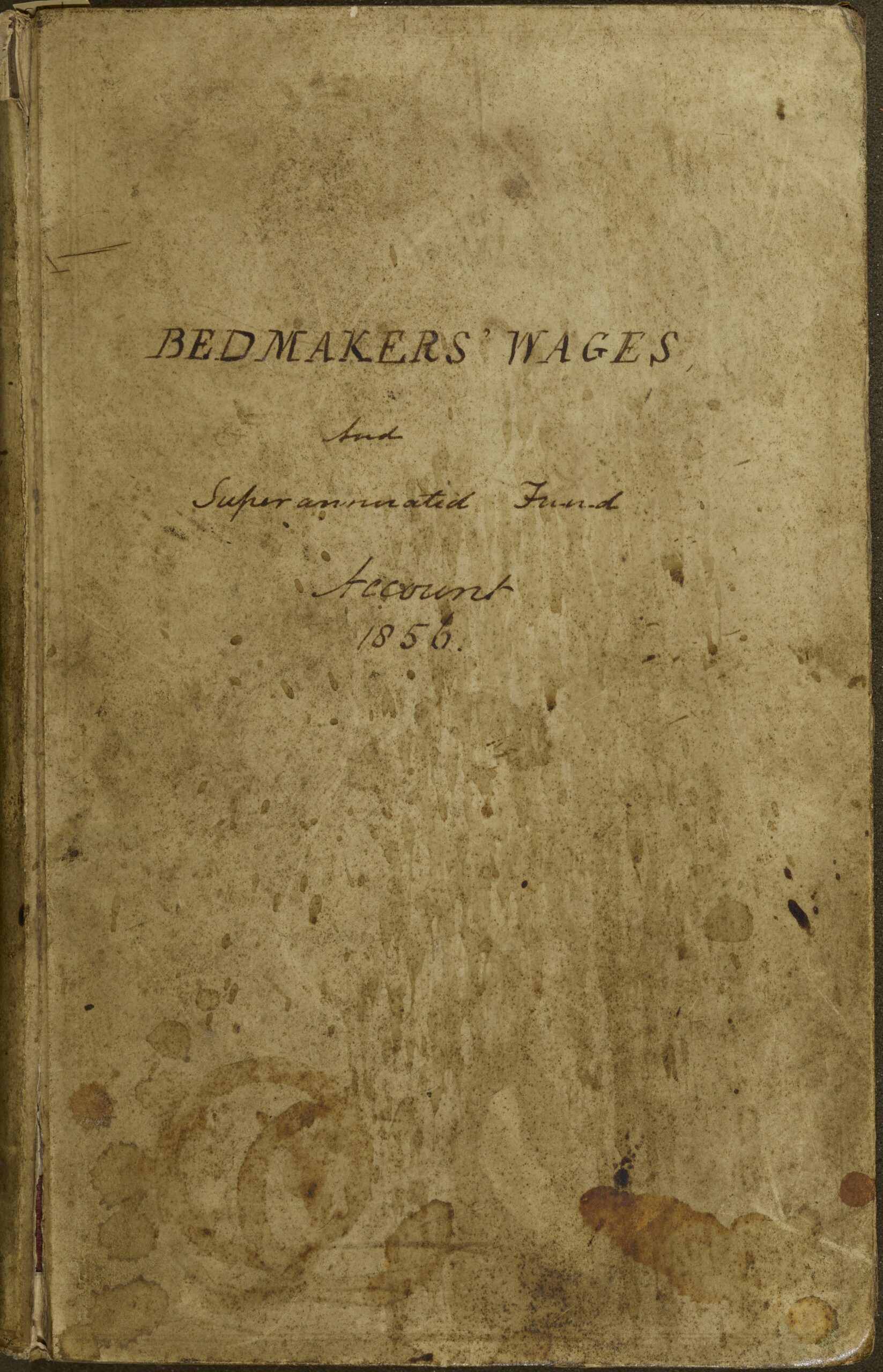
This book, recording wages and pensions paid to bedmakers (‘scouts’), was begun early in the Presidency of Frederic Bulley (1855-85), successor to the long-serving Martin Routh. During Bulley’s first year in office, the governing body passed several decisions (‘acta’) regarding the college servants. These concerned: a £50 pension granted to a bedmaker named Stevens, who was retiring after 56 years’ service; the fixing of stipends at £70 per annum for ‘upper servants’ and not more than £50 for ‘underservants’; a cap on the overall number of servants; and payments into ‘a fund for the maintenance of superannuated servants’.
MCA, CP/2/48
Memoir
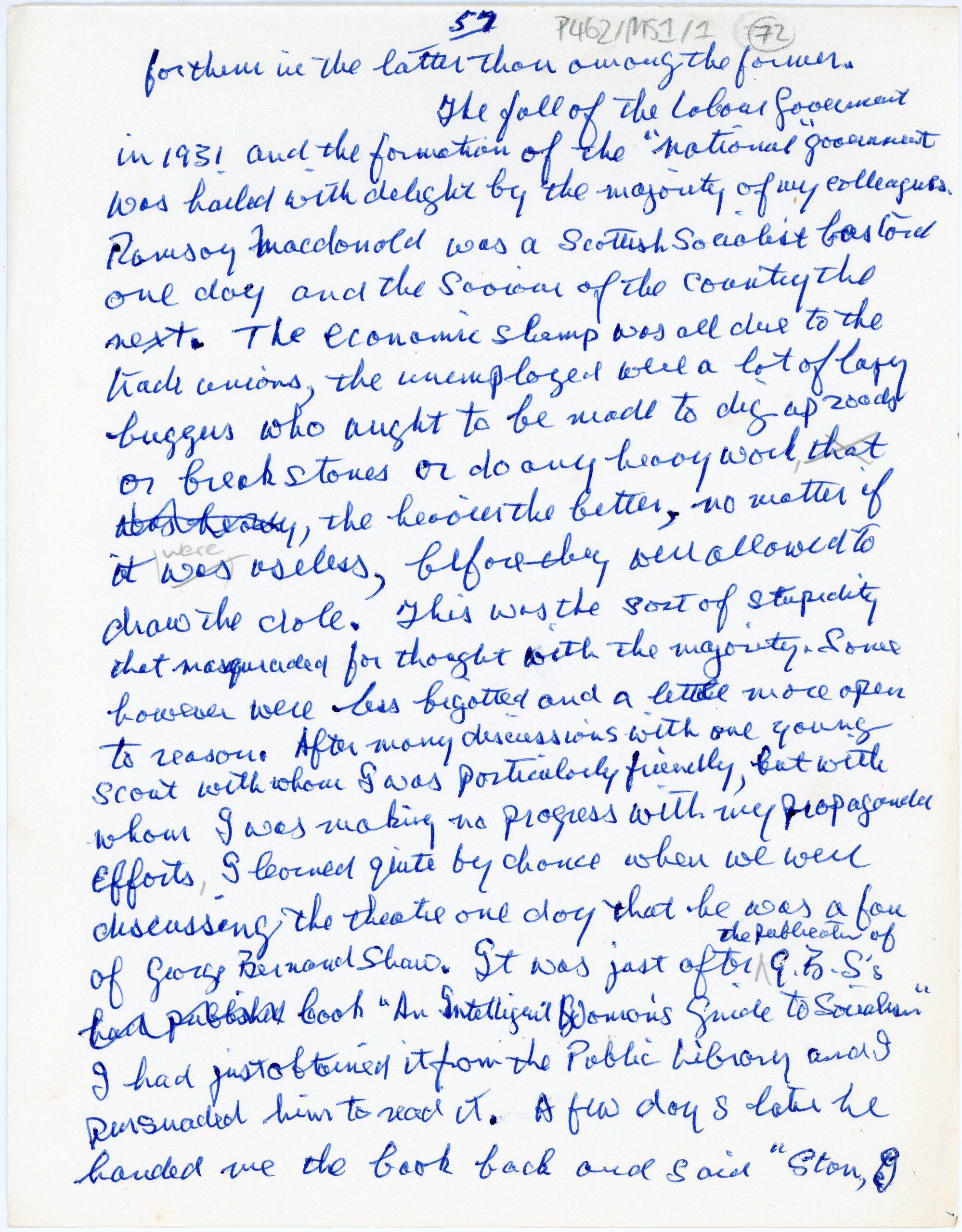
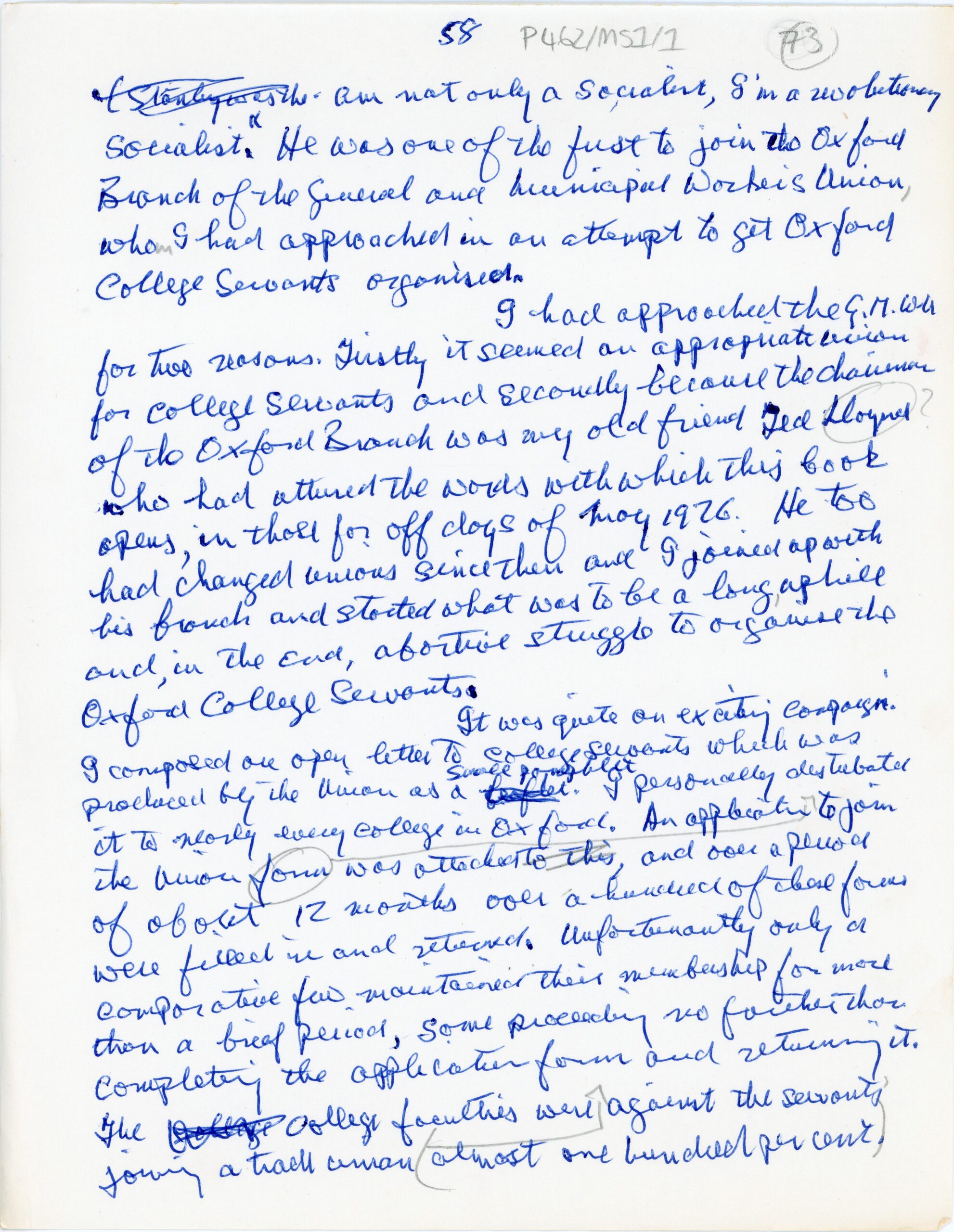
Horace Stanley Richardson joined the Magdalen staff in 1929, following roles as a bicycle mechanic and a factory worker, making parts for Morris cars. A card-carrying trade unionist since age 17, Richardson tried to organise the Oxford college servants during his ten years at Magdalen. In this extract from his memoirs, he attests to a general conservatism among his colleagues. There were exceptions, however, like a young scout who declared himself ‘a revolutionary socialist’ and joined the General and Municipal Workers’ Union after reading George Bernard Shaw, An Intelligent Woman’s Guide to Socialism, at Richardson’s suggestion.
MCA, P/462/MS1/1, pp. 72–73
Letter
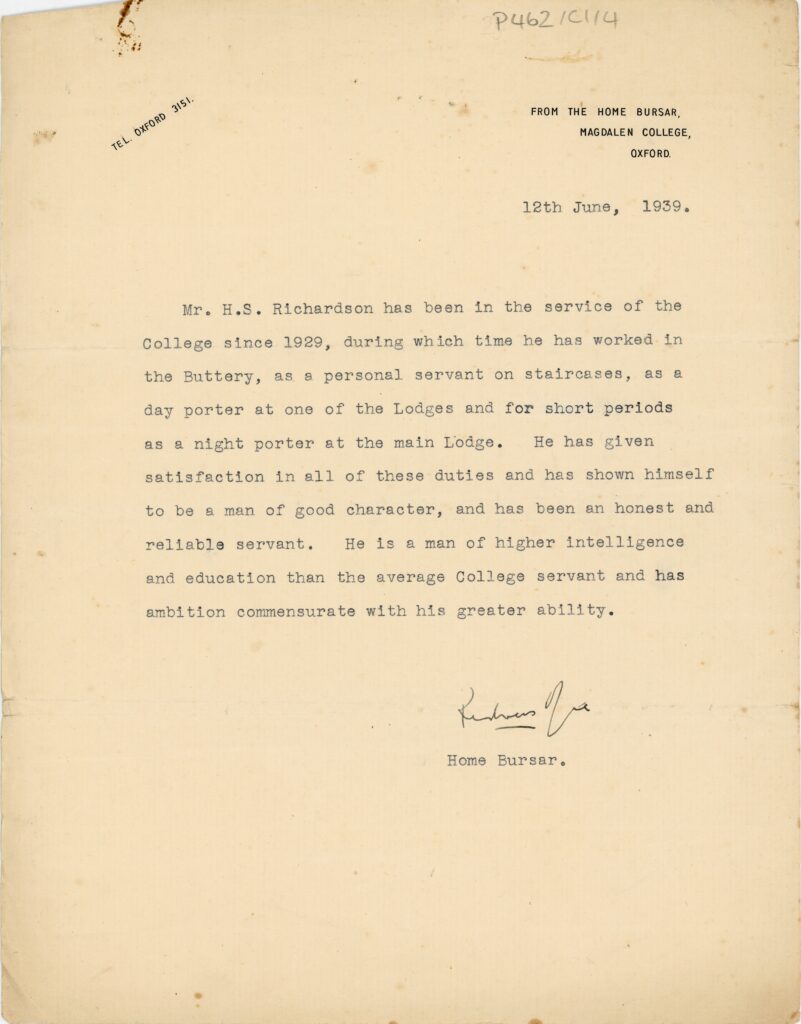
Horace Stanley Richardson worked as a buttery (servery) hand, scout, and lodge porter at different times in his decade at Magdalen. His memoirs vividly describe the toilsome working conditions for college staff. They also chronicle his efforts to unionise Oxford college servants in the 1930s. These attracted scant enthusiasm and made him so unpopular with colleagues that his position at Magdalen eventually became untenable despite support from Fellows like Redvers Opie, the Home Bursar. Opie wrote this positive reference letter for Richardson in June 1939, to assist his efforts to secure employment after leaving Magdalen.
MCA, P/462/C1/4
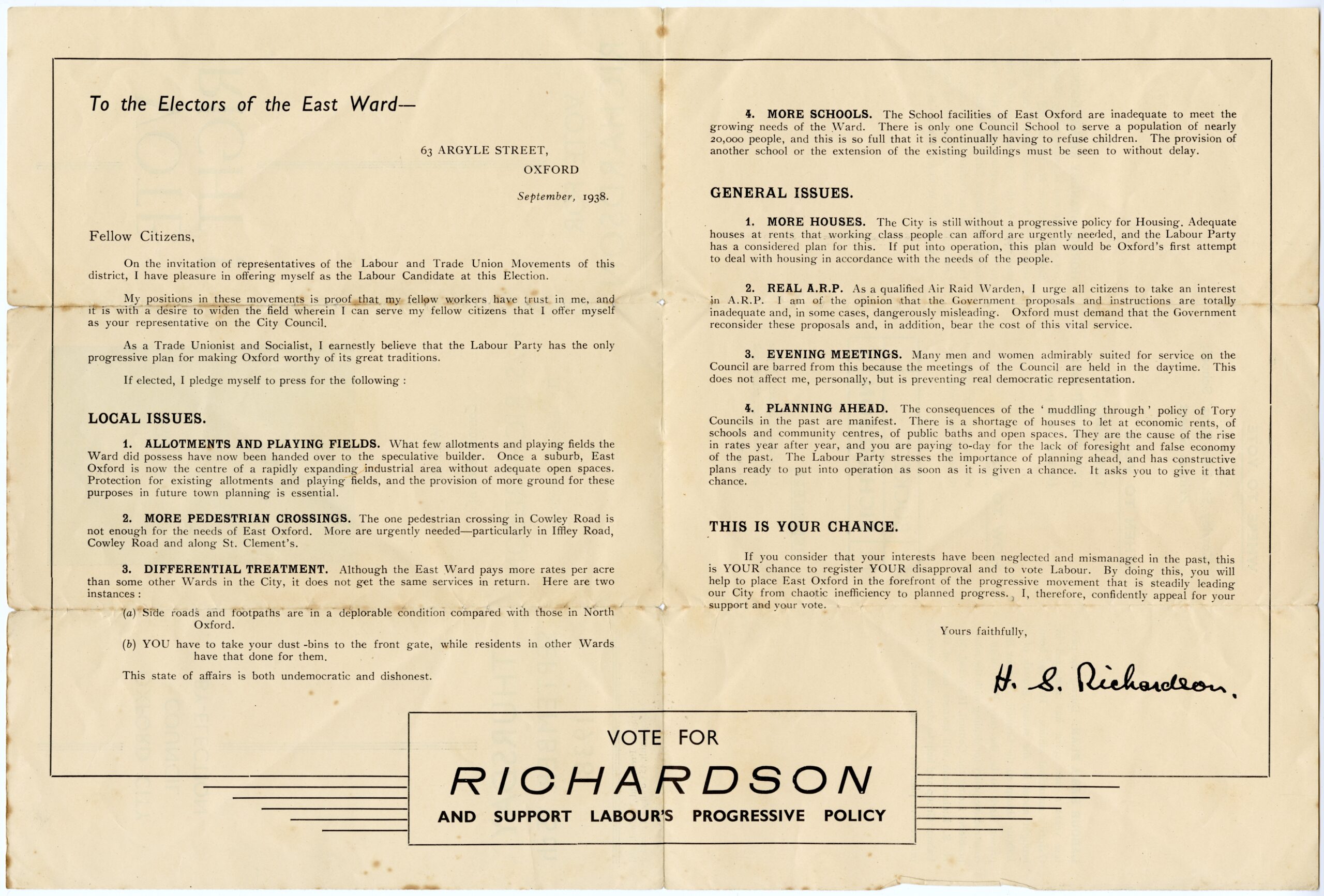
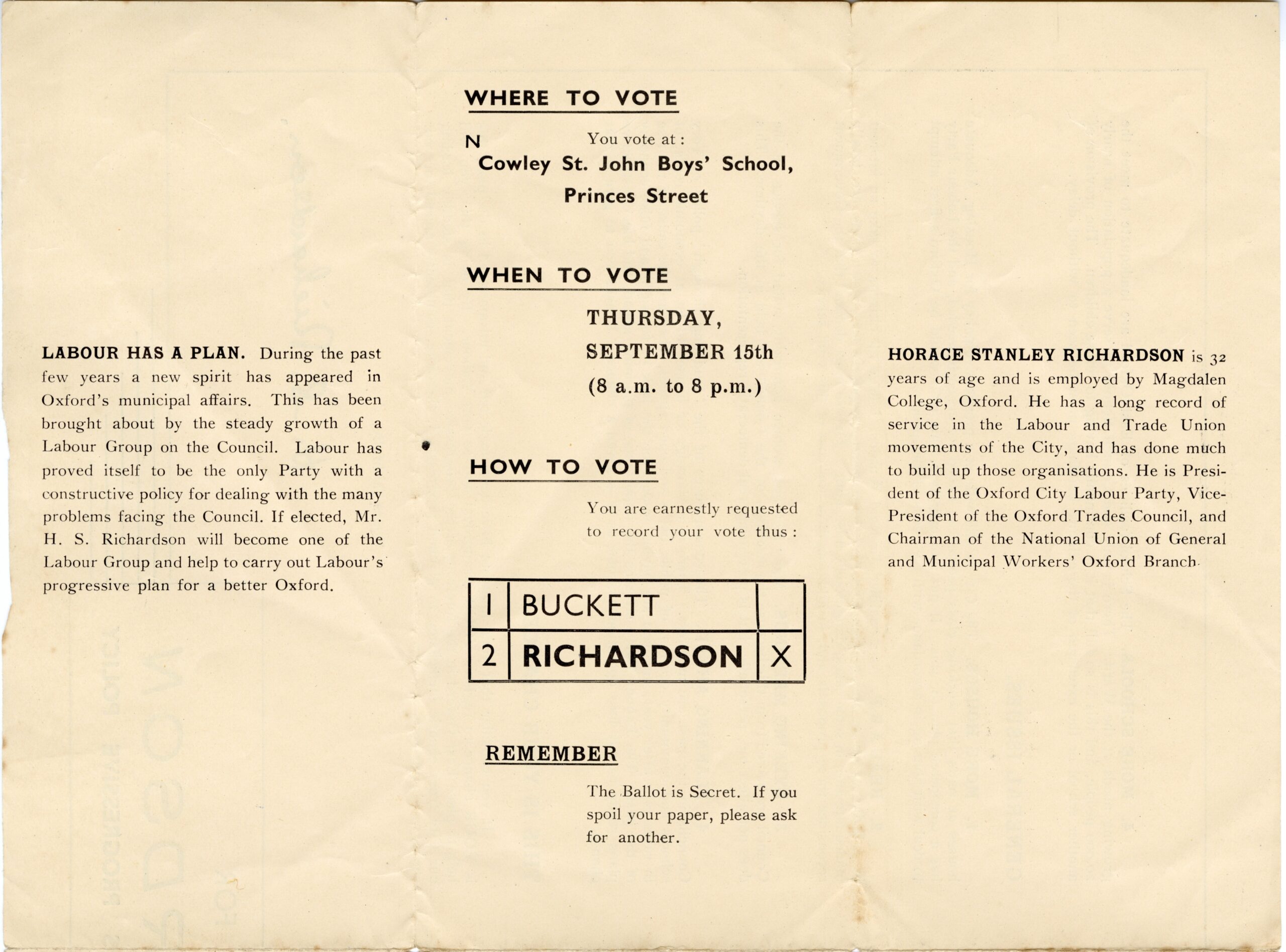
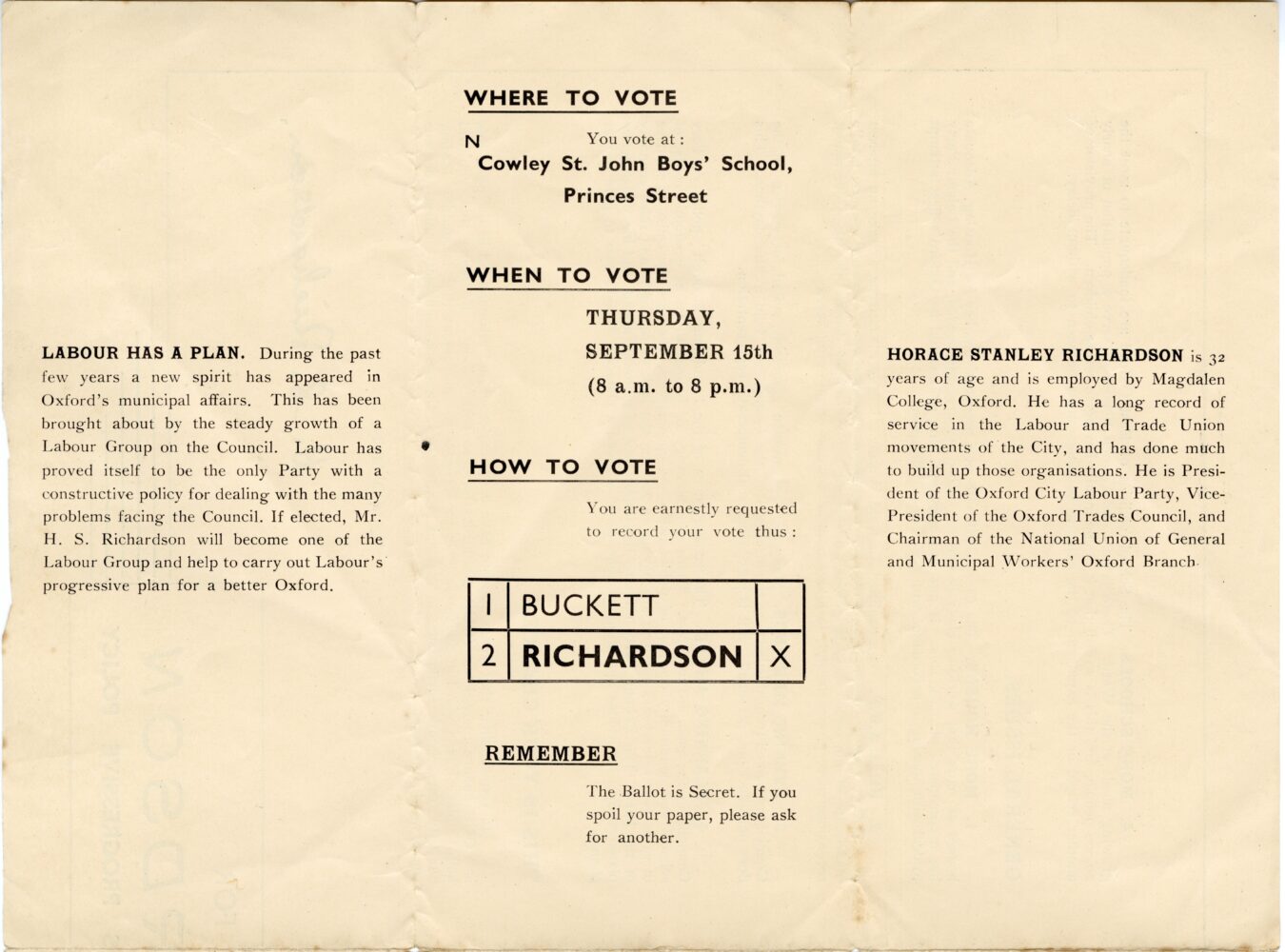
Political pamphlet
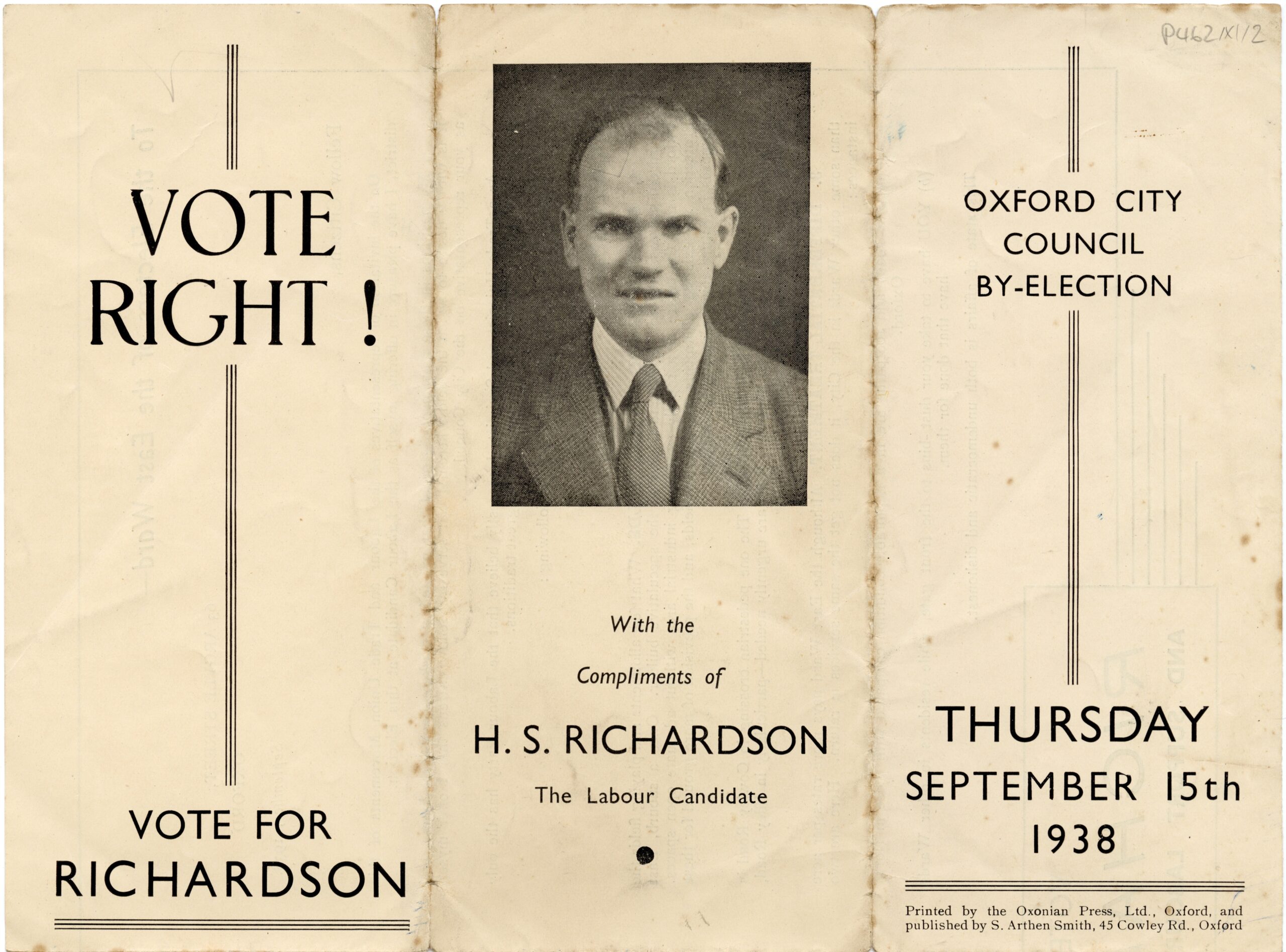
Horace Stanley Richardson, who attempted to unionise his fellow Oxford college servants in the 1930s, was also politically active in his life outside Magdalen. Besides his compelling memoirs, the college archives are home to various of Richardson’s papers including this leaflet, produced for his campaign as the Labour candidate for the East Ward in the Oxford City Council by-election of September 1938. Richardson’s manifesto calls for more and better housing ‘at rents that working class people can afford’, additional school places to meet the needs of East Oxford’s growing population, and more open spaces such as allotments and playing fields.
MCA, P/462/X1/2
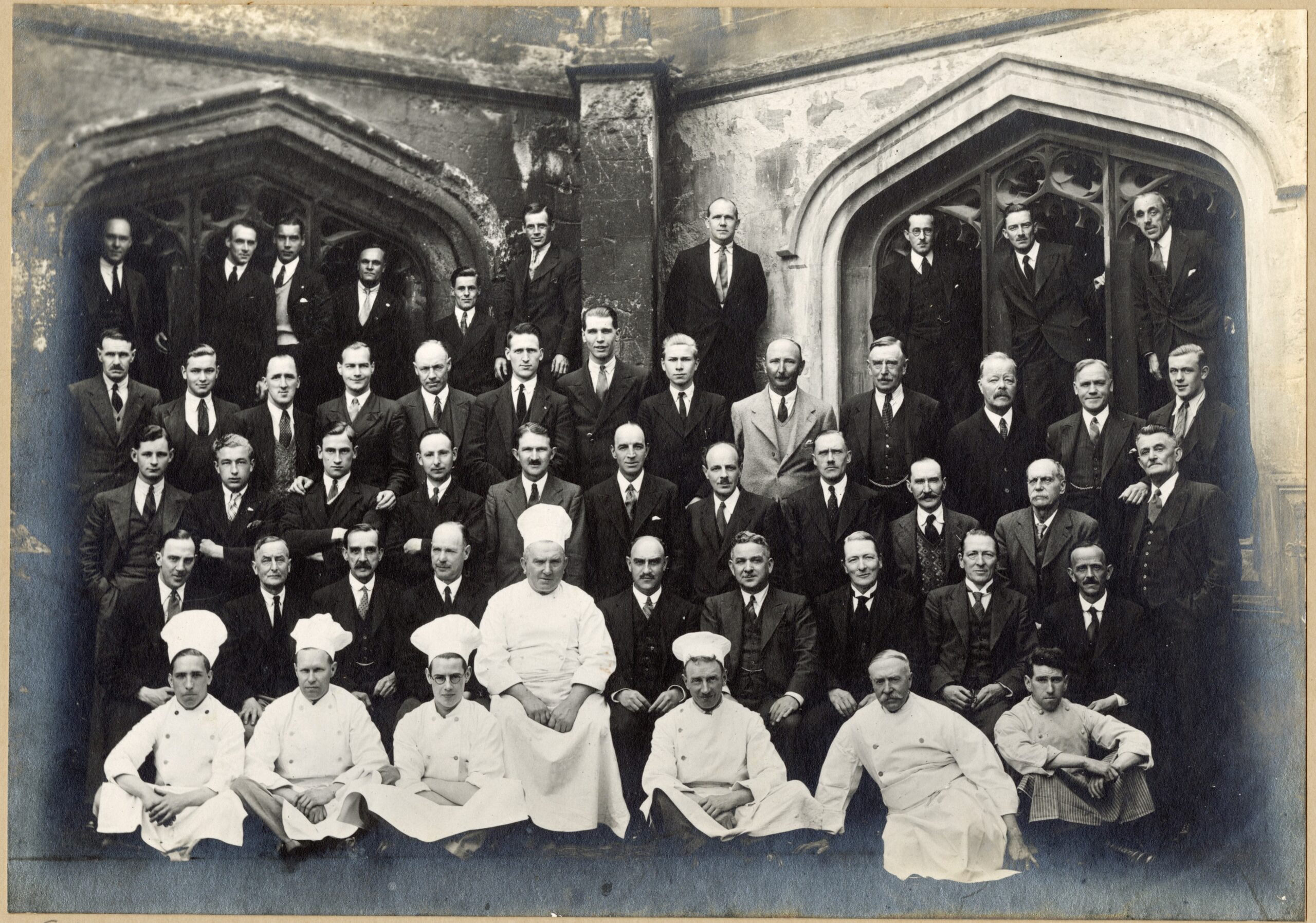
Staff photo
Richardson is not among the sitters for this photograph of the Magdalen staff, taken in 1935. Seated at the front are several of the kitchen staff, with whom he would have worked closely as a buttery hand. These include the long-serving Second Chef, Bill Jarvis (front row, third from left). Among the other sitters are scouts Reg Betnay and Tom Charlett, and two William Spindlers, father and son. Spindler junior was the star bowler on the Magdalen servants’ cricket team in the 1950s.
MCA, CF/1/11